Insights — Essay
Why physical media is the last frontier
Seen from orbit, a city at night is a map of attention. Every lit line is a street, and almost every street now carries a screen that wants something: a few seconds of focus, a scan, a scroll, an email address. Digital media has become extraordinarily good at the asking. It has become correspondingly poor at the giving.
The attention market is full
The economics of attention media are simple and, by now, exhausted. Supply of surfaces grows faster than supply of human seconds. Each new panel, feed and pre-roll enters the same auction for the same finite resource, and the price of being noticed rises while the value of being noticed falls. Audiences respond the way any market participant responds to a saturated offer: they look away, install a blocker, or simply stop registering that the surface exists.
This is not a creative problem. Better copy and sharper art direction do not change the arithmetic. The problem is structural: the medium is built around extraction. It takes first and gives later, if at all. Most people have learned to price that bargain accurately, which is why the most expensive word in modern marketing is "unskippable".
Presence is not participation
Physical space has the one thing the feed can never buy. A person in a flagship store, a museum hall, a cinema lobby or a trade-show aisle is not half-watching from a sofa. They have chosen to be there, they have a body in the room, and for a few minutes they are entirely present. Presence is the scarcest raw material in media, and physical venues hold all of it.
And yet physical media has mostly spent that material imitating digital. Put a screen above the counter and loop the campaign. Wrap the window in a poster. Add motion, add sound, add a QR code in the corner. The surface changes; the bargain does not. The visitor is present, but still on the outside of the story, still being asked rather than offered. Presence has been converted into another impression.
The gap between those two words — presence and participation — is where the next medium lives. A person who is physically in a space can do more than look at a brand world. They can be in it. Nothing about the technology of the last decade made that possible at the speed of a passing guest. That has changed.
The question is no longer how many people saw the campaign. It is how many people were in it.
What a mirror changes
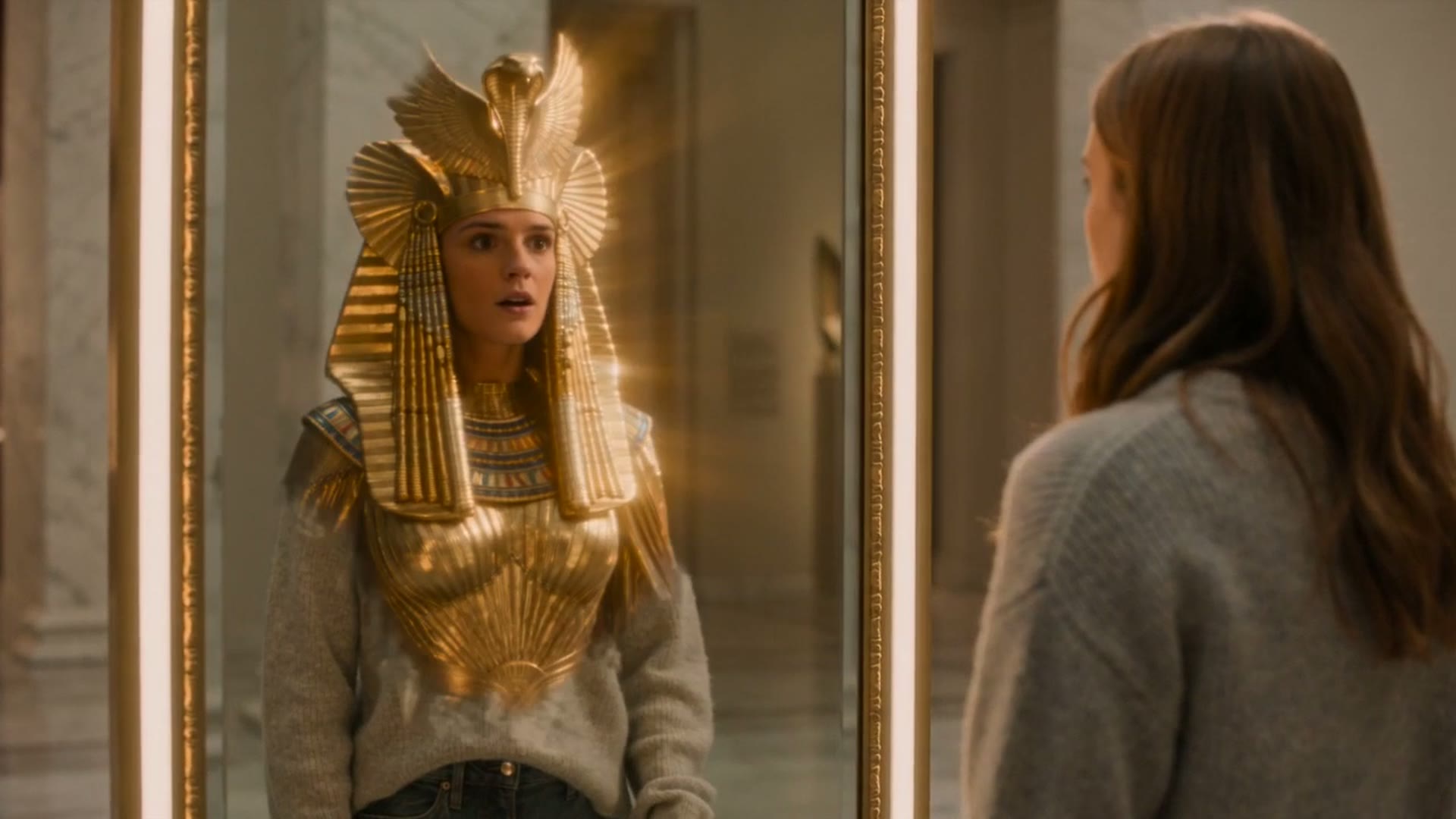
The Manifest Mirror is a mirror-format display with a camera. A guest steps in front of it and sees themselves — not an avatar, not a still photograph taken and processed, but continuous live video — transformed into a brand world. The wardrobe changes. The setting changes. The light changes. The face does not.
That last point is the whole product. Identity lock keeps the guest's face, skin tone, age, expression and body proportions intact while everything around them is rewritten by the generative engine. A visitor in a museum becomes a queen of Egypt and still recognises herself. A fan in a store sees themselves in the kit, in the real store, with the real light behind them. The moment a face drifts, the effect collapses into a trick. When it holds, the guest does not watch a campaign. They are cast in one.
The rest of the design follows from the same logic. A session runs ninety seconds by default — long enough to try several moments, short enough that a queue keeps moving. The guest's own phone becomes the remote by scanning a QR code, so nobody has to install anything. Moments can be switched mid-session, because choosing is part of participating. Afterwards the recording arrives by email, and the guest leaves with something that belongs to them.
Value first, attention second
We call this Value-First Media, and it is a sequencing rule more than a slogan. The person in front of the medium receives something of real value — a transformation, a laugh with a friend, a video of themselves they actually want — before anything is asked of them. No form to fill in to get started. No account. No trade of data for entertainment.
Inverting the order changes what the medium can honestly expect in return. Attention given freely after a gift is different in kind from attention captured by interruption. A guest who has just seen themselves as a samurai will watch the brand's name at the end of their own recording. A visitor who shares that recording is not passing on an advertisement; they are passing on a picture of themselves. The distribution is a by-product of the value, not a tax on it.
It also changes consent. Because the value arrives first, asking comes later and can be asked properly: the camera starts only with agreement, the AI notice is visible, the recording is delivered to an address the guest typed themselves, and it is deleted from our systems after seven days. Permission given by someone who is delighted is worth more, legally and commercially, than permission harvested from someone who was not paying attention.
The unit of participation
Attention media measures impressions, an estimate of how many eyes might have passed a surface. Participation media measures something with edges: a session that started, a session that completed, a recording that was delivered, a follow-up that someone opted into. These are not proxies for interest. They are records of a decision a person made with their body, in a place, at a time.
That precision is what makes physical venues interesting as infrastructure rather than as inventory. A venue with footfall already owns the presence. It has historically monetised that presence by renting out wall space at the price of a glance. The same square metre, used for participation, produces sessions instead of impressions and sends every guest home with an artefact carrying the venue's name. The economics of the floor change without the floorplan changing.
The last frontier
Nearly every surface that can be turned into participatory media already has been. The phone, the desktop, the television, the car dashboard, the watch. Each conversion created a category and a generation of companies. What remains is the physical world itself — the lobby, the concourse, the aisle, the exhibition hall — where billions of people spend their days fully present and almost entirely unaddressed except by posters.
It is the last frontier because it is the last large surface where presence exists without participation, and because it cannot be won by software alone. It needs a physical endpoint people will walk up to, an engine fast enough to answer within a glance, a creative layer that can build worlds in days, an operations layer that can run a fleet across venues, and a marketplace that matches brands to floors. That is the platform we are building, and the mirror is only where it begins.
The industry spent two decades learning how to interrupt people more efficiently. The opportunity now is to stop interrupting and start handing something over. In a room full of people who are already present, that is not a small change of tactics. It is a different medium.
The mechanism
How presence becomes participation
Four steps, ninety seconds. Each one moves the guest further inside the story instead of further past it.
- Notice
The mirror runs in attract mode. A passer-by sees a moving world and, in it, a shape the size of a person. Nothing is asked yet.
- Step in
The guest agrees, the camera starts, and the phone becomes the remote by scanning a QR code. No app, no account, no download.
- Become
The engine transforms wardrobe, setting and light in continuous video while identity lock holds the face, proportions and expression. Moments can be switched mid-session.
- Take it home
The recording is delivered by email. The guest leaves with something of their own; the venue leaves with a completed session and consent given knowingly.
Two models
Attention media and Value-First Media
The same floor, the same footfall, a different bargain with the person standing on it.
| Attention media | Value-First Media | |
|---|---|---|
| Unit of measure | Estimated impressions | Completed sessions |
| What the person gets | An interruption | A recording of themselves |
| Time with the medium | Seconds of glance | 90 seconds of participation |
| Order of exchange | Asks first | Gives first |
| Consent | Assumed by presence | Given before the camera starts |
| Take-home | None | Email delivery, deleted after 30 days |
| Creative refresh | A new asset per campaign | A new moment inside an existing world |
| Sharing | The brand's message | The guest's own picture |
Recordings are removed from our systems after seven days; email deliveries expire after thirty. See Privacy & Compliance.
Where the argument lands
Presence is already everywhere
Every venue that people choose to enter is a surface with participation waiting inside it.
Museums and culture
Visitors arrive curious and stay for hours. A mirror lets them wear the exhibition instead of reading about it, and sends the memory home for them.
Museums & CultureRetail and flagship
Outfit-only mode keeps the real store in the background, so the collection appears on the guest where they are standing — no fitting room, no friction.
Retail & FlagshipCinema and entertainment
A lobby is a waiting room with an audience already in character. The mirror casts them in the release they came to see.
Cinema & EntertainmentRead next
More from the series
Essays on the format, the technology and the business of participation media.

The 90-second rule
Why a session is ninety seconds by default, and what that length does to queues, costs and delight.
Read the essay
Identity lock
Why the face must never change, and how the prompt stack pins identity first and last.
Read the essay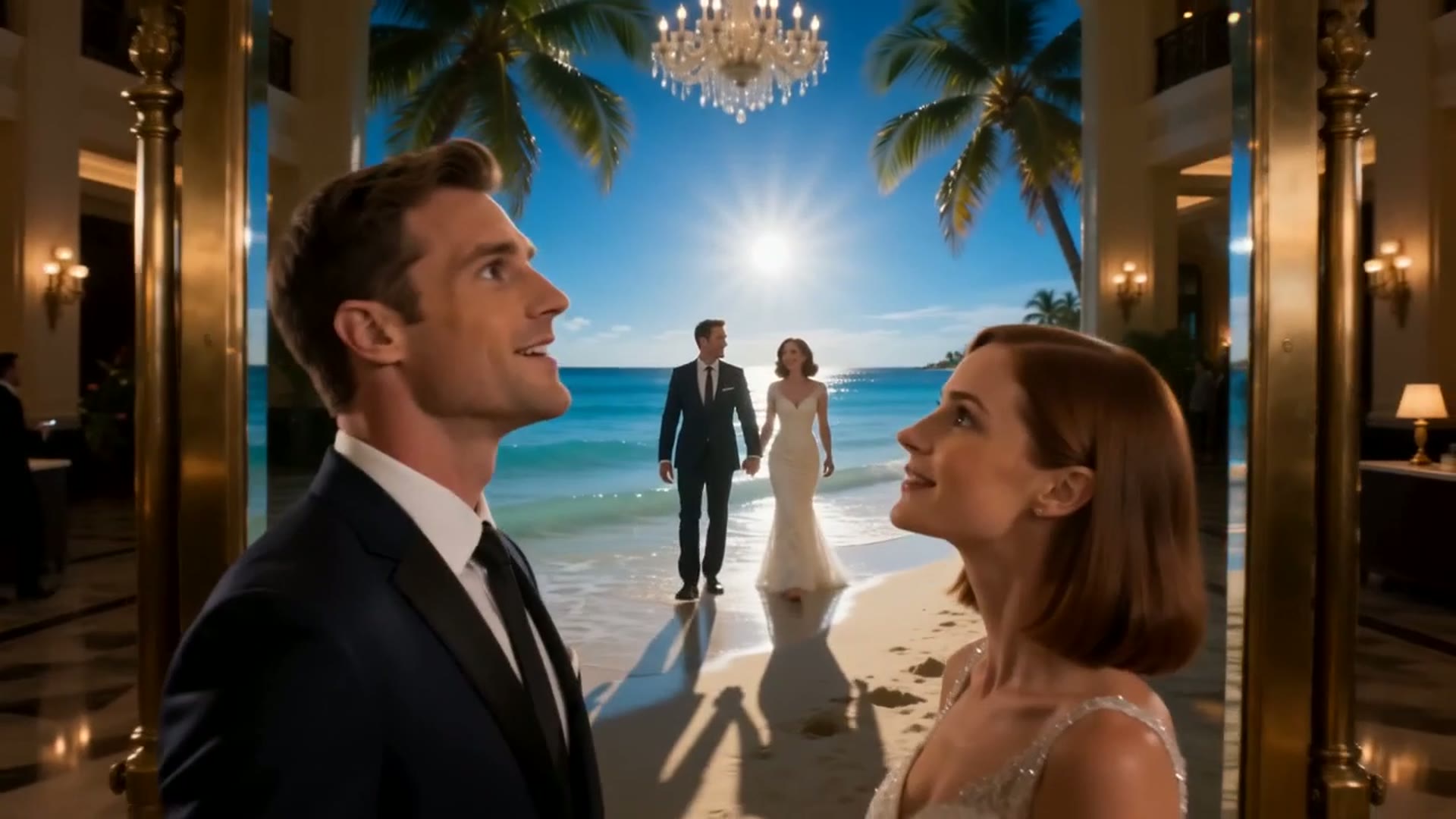
Platform architecture
From camera to mirror in one glance: the six layers that make participation media operable across venues.
Explore the platform